
June 25, 2026· Brad J. Henderson
I Led 600 People I Couldn't Fire. Here's What Hostage Negotiators Taught Me.
Leading 600 independent contractors at Sotheby's taught me what hostage negotiators have known for decades: persuasion beats authority every time.
When I became president of Sotheby's International Realty Canada, I inherited something unusual: a team of 600 people I had no authority over.
They were independent contractors, spread across a geography as large as any organization in Canada can operate across. I could not fire them, reassign them, or direct them through any of the organizational levers that most leadership structures assume you have. If an agent decided my vision was not worth following, they could simply not follow it. There was nothing I could do.
The only tool available to me was persuasion.
This was the exact same lesson I learned decades earlier at LePage, which turned out to be the most valuable leadership education I have ever received. And I have since come to believe that leaders who learned to lead without authority before they held it are, as a consequence, significantly better at exercising authority when they eventually do.
It is exactly what hostage negotiators have understood for decades.
What Hostage Negotiators Figured Out First
In Never Settle, John Richardson of MIT's Sloan School of Management and Attia Qureshi of AQ Consulting describe the moment in hostage negotiation that surprises most people: the most reliable way to get a hostage released is to offer the hostage-taker a sandwich.
Not a negotiated deal. Not a threat. Not a concession. A sandwich.
The underlying principle is reciprocity, one of the most consistent and powerful forces in human psychology. When someone does something genuinely kind for us, we feel an almost compulsive need to respond in kind. In a hostage situation, where negotiators have zero leverage, a small, unexpected act of genuine care can produce compliance that no amount of pressure could.
Chris Voss, in Never Split the Difference, arrives at the same insight from a different direction. As the FBI's lead international hostage negotiator, Voss developed what he calls tactical empathy: the deliberate practice of understanding and articulating what the other person actually feels and needs. Not what you want them to feel. What they actually feel.
Both books are making the same argument: the leaders and negotiators who move people most effectively are not the ones with the most leverage. They are the ones who have done the work to understand what the other person genuinely needs, and who have demonstrated, through consistent and human action, that they care about it.
At Sotheby's, with no leverage available, I did this instinctively. What the research now confirms is that it works.
The Sandwich, in Practice
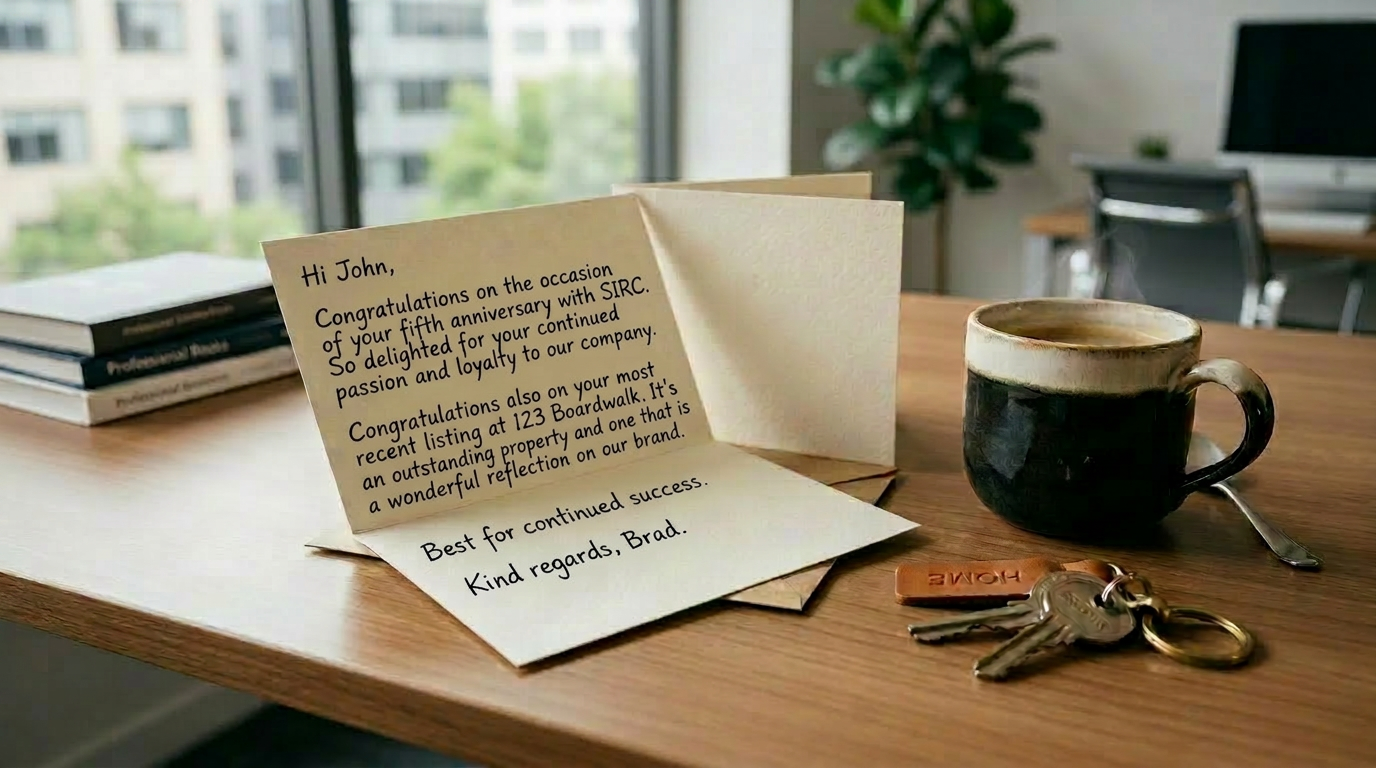
I sent handwritten cards to every agent on special work anniversary. Not an email. A card, written by hand, acknowledging the specific milestone.
When an agent secured a new listing, particularly a landmark property, I wrote to congratulate them by name and by address. Not a form letter. A note that named the property and acknowledged what the achievement represented for the agent and for the brand.
And whenever I was in any of our offices across Canada, from the largest to the smallest, I stopped to say hello to people. No meeting required. No agenda. Just a few minutes with the people who were there, because they were there.
Each of these things, taken individually, takes only a few minutes. None of them appears on any leadership competency framework. None of them is mentioned in most executive development programs.
Together, they built something that no organizational chart can manufacture: the sense, in each of those 600 people, that the person leading this organization actually saw them as individuals rather than as units of production.
That is the sandwich. And it is the foundation on which everything else is built.
Richardson and Qureshi describe reciprocity not as a manipulation tactic but as a natural consequence of genuine human investment. The agents who felt seen were the agents who brought their best work. The ones who received a personal note on a landmark listing were the ones most likely to bring the next landmark listing to the brand rather than to a competitor. The goodwill was real because the investment was real.
Know Their Interests Before You Ask for Anything
Richardson and Qureshi make a distinction that most leaders overlook: the difference between a position and an interest.
A position is what someone says they want. An interest is why they want it. The two are often quite different, and the gap between them is where most leadership conversations fail.
A real estate agent's position might be: I want more flexibility in how I price my listings. Their interest is almost always something deeper: I want to be trusted as a professional. I want to feel that the organization respects my judgment. I want to know that my experience with my clients counts for something.
Those are entirely different conversations. And you cannot have the right one until you understand which one you are actually in.
Voss calls the technique for getting there tactical empathy. Not sympathy, which asks you to feel what the other person feels. Empathy, which asks you to understand it clearly enough to articulate it back to them. When you can describe what someone cares about more precisely than they can describe it themselves, the dynamic of the conversation shifts. They stop defending their position and start listening to yours.
My town halls and video podcast at Sotheby's were built on this. Not to broadcast strategy, but to demonstrate that I understood what agents were actually navigating: market pressure, client expectations, the particular difficulty of representing a luxury brand in a market where not every listing fits the brand's positioning, and the geographic isolation that meant an agent in a smaller city could feel disconnected from the national presence.
Before I asked anyone to follow a direction, I made sure they knew I understood the direction they were already in.
The Internal Negotiation Most Leaders Skip
Before any significant leadership conversation, Richardson and Qureshi recommend what they call the internal negotiation: the work you do before you walk into the room.
It has two parts. The first is emotional: acknowledging and managing the feelings you carry into a high-stakes conversation. Research suggests that 90 to 95 per cent of decision-making is driven by unconscious emotional processing. A leader who walks into a difficult conversation carrying anxiety, defensiveness, or the residue of the last disagreement is already at a disadvantage before anyone has said a word.
The second part is interest clarity: understanding what you actually care about in the conversation, not just what outcome you want. Your position might be: I want agents to adopt this new technology platform. Your interest is: I want agents to spend less time on administration and more time with clients, because that produces better results for them and for the brand. Those two conversations land differently with someone who is resistant to change.
The leaders who do this preparation are more flexible in how they reach an outcome, more confident when the conversation does not go as planned, and more credible in the room because they are not defending a position. They are sharing an interest. And interests are almost always harder to argue with than positions.
Why Leading Without Authority Builds Better Leaders
Here is what I have come to believe, from decades of leading in contexts that ranged from organizations where I had full authority to one where I had none:
The leaders who learned to persuade before they had authority are better at exercising authority when they eventually hold it.
The reason is not complicated. People who operate without positional power are forced to develop a quality of attention to others that authority makes optional. They have to listen more carefully, because listening is the only tool they have. They have to understand interests more deeply, because compliance is not available as a fallback. They have to build trust more deliberately, because trust is the only currency that actually moves people who do not have to move.
When those leaders eventually hold authority, they continue using these tools. Not because they are required to. Because they have learned, from direct experience, that the tools work better than authority ever did.
Authority produces compliance. Persuasion produces commitment. And commitment is the only condition that generates the discretionary effort that drives exceptional organizational performance. The difference between a team that does what is asked and a team that does more than was asked is almost never a function of authority. It is almost always a function of the quality of relationship between the leader and the led.
This is what the hostage negotiation literature has understood for decades, and what the best leadership research is now confirming: the leaders who get the most from the people they lead are the ones who have made those people feel genuinely seen, understood, and valued, before asking them for anything.
Three Things Worth Practising Now
From the negotiation literature and from what I learned leading without authority, three practices have stayed with me across every leadership context since.
The first is building reciprocity before you need it. Small, consistent, personal investments in people create the goodwill that makes them willing to follow when the direction is difficult or the ask is large. A handwritten card is not a management strategy. A drop-in with no agenda is not a productivity tool. They are human gestures. The fact that human gestures build human trust should not need to be written in a leadership book. But in organizations that have systematized everything, it often does.
The second is asking about interests rather than positions. Before any significant conversation, ask yourself what the other person actually cares about. Not what they say they want. What they need beneath what they say they want. You do not have to agree with their interests to understand them. But you cannot lead someone whose interests you have never tried to understand.
The third is giving people a genuine no. Voss's most counterintuitive insight is that people need to feel safe saying no before they can say yes and mean it. A yes extracted under pressure is compliance. A yes offered freely, after a real choice, is commitment. The leaders who create genuine buy-in are the ones who make it clear that the choice is real, and who have built enough trust that choosing yes feels like the right answer.
The Question Worth Asking
The agents at Sotheby's International Realty Canada followed the vision not because I could require it. They followed it because, over time, they had come to feel that the person leading the organization understood what they did, respected how they did it, and was genuinely invested in their success, not just the brand's.
That is the thing authority can never manufacture and persuasion, done consistently over time, always builds.
If you are a leader with full authority over your team, I want to offer you a question worth sitting with: if you removed the authority tomorrow, would the people you lead still follow you? Would they know, from the specific and personal way you have engaged with them, that you see them as individuals and not as resources?
If the answer is yes, you have built something real. If the answer is uncertain, the gap is not a performance issue. It is a relationship one. And it closes the same way all relationship gaps close: through small, consistent, genuine investment, before you need it, for long enough that it becomes something the other person did not expect and cannot easily forget.
As I write in The Consistency Effect, the most durable influence you can build is not the kind you exercise. It is the kind you earn. Earn it before you need it, through the small and human gestures that signal, more clearly than any vision statement ever could, that the people you lead actually matter to you.
If you are a senior leader who wants to build the kind of followership that persists beyond your title, I would welcome the conversation. Reach me at bradhenderson@me.com.
The leaders people remember are rarely the ones who had the most authority. They are the ones who made people feel seen.